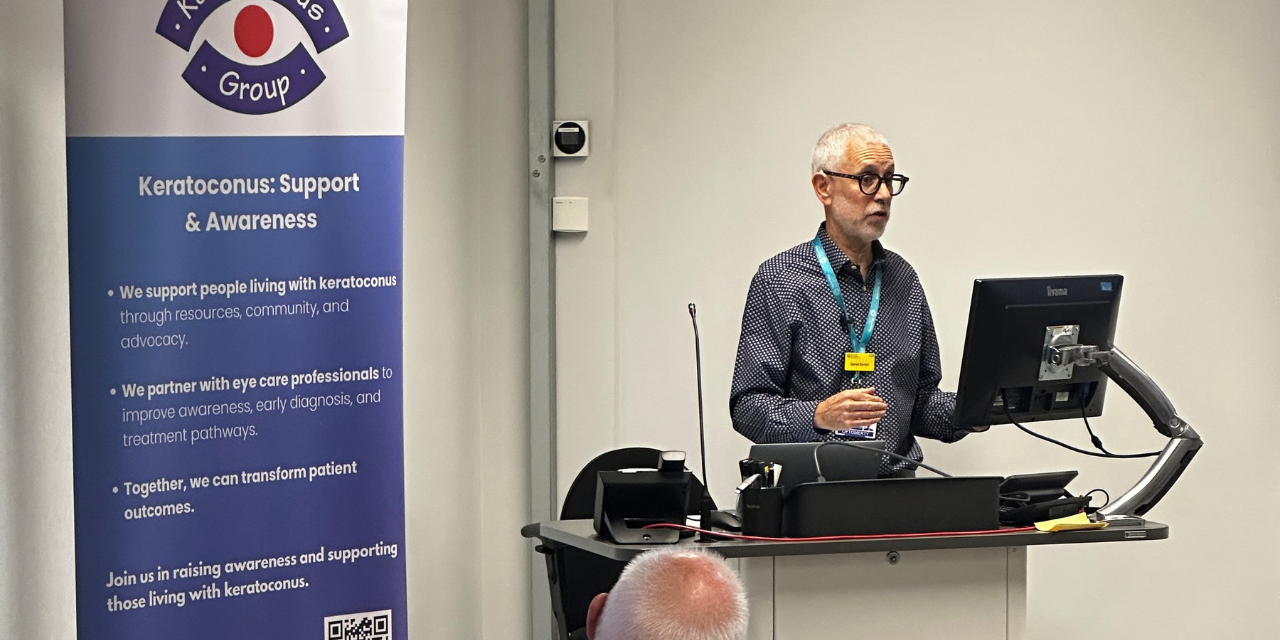
At our recent London Speaker Meeting, we were delighted to welcome Dan Ehrlich, former Head of Optometry at Moorfields Eye Hospital, to talk about his recent research into specialist contact lens fitting for people with keratoconus.
For many people with keratoconus, rigid gas permeable (RGP) contact lenses play an important role in providing useful vision. However, finding the right lens can sometimes involve trying several different lenses before the best fit is identified.
Dan and his colleagues have been investigating whether information already collected through modern corneal imaging could help make this process more efficient and provide clinicians with another tool when selecting specialist contact lenses.
Using eye scans to help choose a contact lens
Many people attending a keratoconus clinic will be familiar with having detailed scans taken of their cornea. These scans provide clinicians with information about the shape, curvature and thickness of the cornea.
Dan explained that clinics also hold information about the contact lenses patients have been successfully wearing. His research looked at whether these two sources of information could be brought together to help with contact lens fitting.
The team investigated a virtual contact lens fitting system available through the Pentacam HR corneal imaging device. Using information from a patient’s corneal scan, the software can simulate how a particular contact lens might fit the eye before that lens is physically manufactured and placed on the cornea.
The researchers wanted to explore whether this approach could help practitioners select an appropriate starting lens and potentially reduce some of the trial and error involved in traditional contact lens fitting.
What does a good contact lens fit involve?
Dan also gave members an interesting insight into what practitioners are actually looking for when they examine a contact lens on the eye.
During a contact lens appointment, fluorescein dye and a blue light can be used to show the relationship between the lens and the cornea. Practitioners look at factors including how closely the lens aligns with the cornea, how much clearance there is around its edge, where the lens sits and how it moves when the wearer blinks or looks in different directions.
Getting this balance right is important. A lens needs to provide good vision, but comfort and the health of the eye are also important considerations.
Because keratoconus causes the cornea to become irregular in shape, achieving the right fit can require considerable clinical skill and sometimes trying a number of different lenses.
Putting virtual fitting to the test
Dan described several work packages of research carried out by the team.
The researchers compared lenses selected with the assistance of the virtual fitting software with lenses that patients were already successfully wearing. They also explored what happened when specific changes were made to the design of a lens.
A further part of the research compared the conventional contact lens fitting process with one assisted by the virtual system. The team considered factors including the fitting process, the number of lenses that needed to be placed on the eye, the time taken to fit lenses and patients’ experiences of the different approaches.
Clinicians at Moorfields were also invited to use the software so that the researchers could assess how practical it was for practitioners to use.
Dan shared the findings of this work with those attending our London meeting. However, as the research results have not yet been published, we are unable to report the detailed findings here. However, the headline results are that the study established that using the ‘virtual fitting’ module reduced the amount of lenses needed to be places on the eye and the time taken to fit RGP contact lenses – as well as being preferred by participants.
We hope to be able to share more with members once the research has been formally published.
Technology to support, rather than replace, expertise
One important point from Dan’s presentation was that virtual fitting is intended to assist clinicians rather than replace their expertise.
A corneal scan can provide a great deal of information about the surface of the eye, but it cannot capture every factor affecting how a contact lens will behave. Dan explained that factors such as the eyelids can also influence the way a lens sits and moves.
The potential value of this technology is therefore in giving practitioners additional information before placing a lens on the eye and helping them make a more informed initial choice.
It could also allow clinicians to consider virtually how different lens designs might interact with an individual’s corneal shape before deciding which lens to try.
Asking patients what research should come next
Dan began his session by turning the conversation over to the audience.
He explained that researchers and clinicians often make decisions about what they believe would be useful to investigate, but that patients are not always given enough opportunity to say what would actually make the greatest difference to their lives.
Members were therefore invited to write down the things they would most like clinicians and researchers to improve or investigate.
The discussion generated a wide range of ideas, covering different stages of life with keratoconus. Topics raised included earlier diagnosis and awareness, support following diagnosis, clinic and appointment experiences, contact lens comfort, understanding between patients and practitioners, employment, support for parents and younger people, and the challenges people may face later in life if contact lens wear becomes more difficult.
Ideas for future research were also put forward, including nutrition, the potential role of artificial intelligence in keratoconus management and whether new approaches could provide more options for people who struggle with contact lenses.
Dan plans to take the feedback away and share relevant suggestions with research and clinical colleagues.
It was a valuable opportunity for our members not simply to hear about research, but to have their own experiences and priorities heard by someone who can take those conversations back into the clinical and research community.
An update on scleral lenses at Moorfields
Dan also gave members an update on developments in scleral contact lenses at Moorfields.
The hospital has a long history of manufacturing specialist contact lenses through its own laboratory. Dan explained that Moorfields has been working with BostonSight, a non-profit organisation in the United States involved in scleral lens design, research and innovation.
Following a lengthy process involving manufacturing, quality and regulatory requirements, Moorfields is now manufacturing BostonSight scleral lenses in-house.
Dan explained that the initial focus has been on establishing the service successfully within Moorfields before considering its wider availability.
Looking ahead
Dan’s talk provided a fascinating insight into how advances in corneal imaging and virtual technology could influence the future of specialist contact lens fitting.
While we cannot yet share the detailed results of the research, it was particularly valuable for members to see how researchers are exploring ways of using information already collected during routine eye care to support the contact lens fitting process.
Just as importantly, the meeting demonstrated why the patient voice needs to be part of research. The questions researchers choose to investigate should reflect the issues that matter to the people who ultimately live with the condition.
We would like to thank Dan for joining us and sharing his work, everyone involved in the research, and all our members who contributed questions, experiences and ideas during such an engaging meeting.