
Orginal Article from INSIGHT Health Data Research Hub
Diseases affecting the anterior segment, the front part of the eye, are among the leading causes of visual impairment and blindness globally, yet few large-scale datasets have been available for these conditions. In response, clinical researchers at Moorfields Eye Hospital NHS Foundation Trust and University College London (UCL) Institute of Ophthalmology have developed the world’s most comprehensive anterior segment dataset, CADMUS, comprising more than 900,000 images linked to clinical records.
Cataract and loss of corneal transparency are two of the leading causes of blindness in adults, while in children, loss of corneal transparency is the third most common cause of blindness globally.[1] Other anterior segment conditions, such as keratoconus, disproportionately affect young people and have no cure, relying on early detection and close monitoring to prevent permanent vision loss. However, the health data research tools needed to investigate such conditions have lagged significantly behind.
Less than 10% of publicly available ophthalmic imaging datasets address the anterior segment of the eye, according to a 2021 review in The Lancet Digital Health.[2] More recently, a 2024 review identified 26 anterior segment datasets globally.[3] Of these, 80% originated in either the US, China, or Europe, over half contained predominantly images of normal healthy eyes, and most were incompletely described. The median dataset size across the broader ophthalmic imaging literature was just 50 patients.
In comparison, the CADMUS dataset comprises 945,243 images from 22,482 unique patients, collected during routine clinical care at Moorfields Eye Hospital between December 2019 and September 2024. Approximately 96% of patients have multiple follow-up visits, facilitating the study of disease progression and long-term outcomes. The data reflects the demographic diversity of the Moorfields patient population, with broad representation across ethnicities and age groups typical of London.
Data collection and curation was enabled by INSIGHT, the Eye and Oculomics Health Data Research Hub at Moorfields, which is the world’s largest bioresource of ophthalmic imaging data linked to clinical records. Through INSIGHT, researchers will be able to apply for access to CADMUS, which has been published as a datasheet in Ophthalmology Science.
CADMUS captures a broad spectrum of anterior segment pathology, such as keratoconus, Fuchs’ corneal dystrophy, corneal scarring and cataracts. Over 40,000 surgical records from more than 12,000 patients are detailed, spanning cataract operations, corneal cross-linking, corneal transplant, keratectomy and other corneal procedures. Systemic comorbidities are also captured, including hypertension and type 2 diabetes.
The dataset integrates three complementary data types:
- Raw DICOM images from the MS-39 anterior segment OCT tomographer, including high-resolution radial OCT cross-sections, Placido-disc corneal topography maps, and external eye photographs
- Derived quantitative indices, including keratometry values, pachymetry, wavefront aberrometry, and AI-generated classifier scores for keratoconus and related conditions
- Linked electronic health record data, covering demographics, diagnoses, surgical procedures, visual acuity, and refraction measurements
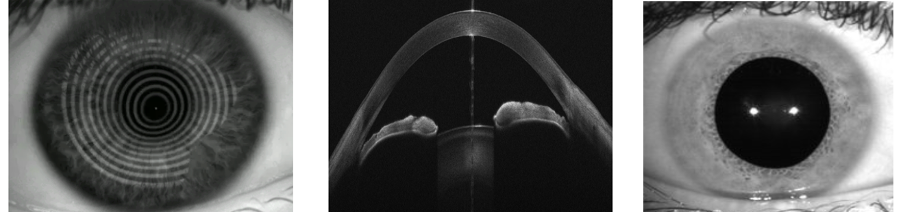
CADMUS is intended to support research into early disease detection, surgical outcome prediction, health equity analysis, and the development of AI tools that can be deployed in real-world ophthalmic practice. The need for resources of this kind is widely recognised. The European Society of Cataract and Refractive Surgeons (ESCRS), which supported development of CADMUS, has committed to annually updating a catalogue of available anterior segment datasets through 2030, acknowledging that the field has, until now, been severely under-resourced.

Datasheet lead author Dr Shafi Balal said: “Early research using CADMUS data has already produced promising results. We have used the dataset to establish precision limits for keratoconus progression measurement, providing a scientifically grounded basis for defining disease progression. We have also trained deep learning models on CADMUS. One model can predict patient age and biological sex from anterior segment scans, demonstrating that routine clinical images carry rich biological signals invisible to the human eye”. Dr Balal is an ophthalmic surgeon at Moorfields Eye Hospital and NIHR doctoral fellow at UCL, supported in his work by NIHR, Moorfields Eye Charity, ESCRS and T.F.C. Frost Charitable Trust.
Datasheet lead author Dr Shafi Balal said: “Early research using CADMUS data has already produced promising results. We have used the dataset to establish precision limits for keratoconus progression measurement, providing a scientifically grounded basis for defining disease progression. We have also trained deep learning models on CADMUS. One model can predict patient age and biological sex from anterior segment scans, demonstrating that routine clinical images carry rich biological signals invisible to the human eye”. Dr Balal is an ophthalmic surgeon at Moorfields Eye Hospital and NIHR doctoral fellow at UCL, supported in his work by NIHR, Moorfields Eye Charity, ESCRS and T.F.C. Frost Charitable Trust.
Senior author Professor Bruce Allan said: “CADMUS exemplifies what is possible when world-class clinical care, robust data infrastructure, and a commitment to open science come together. INSIGHT at Moorfields is helping to translate the NHS’s extraordinary patient data into research breakthroughs, and CADMUS is a prime example. No comparable publicly accessible anterior segment dataset offers longitudinal depth at this scale.” Professor Allan is consultant ophthalmic surgeon at Moorfields Eye Hospital and honorary professor at UCL.
Extraction, anonymisation, and structuring of clinical data in CADMUS was enabled through INSIGHT’s secure cloud-based environment. All patient data is irreversibly anonymised using cryptographic methods, and the dataset operates within an ethical framework approved by the West of Scotland Research Ethics Service. The NHS National Data Opt-Out programme is fully implemented, ensuring patient rights are protected throughout.
Researchers wishing to access CADMUS can do so through INSIGHT’s established Data Use Application process, which includes oversight from an independent patient and public advisory board, and applies the internationally recognised “Five Safes” framework evaluating safe projects, safe people, safe data, safe settings, and safe outputs.
Development of CADMUS has been supported by the NIHR, ESCRS, and T.F.C. Frost Charitable Trust. NIHR and Moorfields Eye Charity are supporting Dr Balal in development of an AI foundation model for the anterior segment trained on CADMUS data.
Lead author Shafi Balal. Shafi’s work with the CADMUS dataset is supported by NIHR, ESCRS and T.F.C. Frost Charitable Trust.
About the INSIGHT Eye and Oculomics Health Data Research Hub
INSIGHT is the world’s largest ophthalmic imaging bioresource, with over 30 million eye images linked to clinical data. An NHS initiative founded in 2019 and led by Moorfields Eye Hospital, INSIGHT makes routinely collected patient eye data available for approved research that could lead to improvements in diagnosis, care and treatment of eye diseases, as well as systemic disease such as stroke and Alzheimer’s. INSIGHT’s mission is to improve healthcare for the benefit of patients, the NHS and wider society by enabling safe and trusted research access to anonymised data for research and innovation. For more information, please visit https://www.insight.hdrhub.org/
About Moorfields Eye Hospital NHS Foundation Trust
Moorfields Eye Hospital NHS Foundation Trust is one of the leading providers of eye health services in the UK and a world class centre of excellence for ophthalmic research and education. Our main focus is the treatment and care of NHS patients with a wide range of eye problems, from common complaints to rare conditions that require treatment not available elsewhere in the UK. Our unique patient case mix and the number of people we treat mean that our clinicians have expertise in discrete ophthalmic sub-specialties.
We treat people in 20 locations in and around London, the south east and Bedford, enabling us to provide expert treatment closer to patients’ homes. We also operate commercial divisions that provide care to private patients in both London and the Middle East.
With our academic partners at the UCL Institute of Ophthalmology, Moorfields is recognised as a leading centre of excellence in eye and vision research. Together we form one of the largest ophthalmic research sites in the world, with the largest patient population in Europe or the USA. We publish more scientific papers than any other eye and vision research site and have an extensive joint research portfolio.
About UCL Institute of Ophthalmology
The UCL Institute of Ophthalmology is one of a number of specialised research centres within UCL (University College London) and is, together with Moorfields Eye Hospital, one of the leading centres for eye research worldwide. The combination of the institute’s research with the resources of Moorfields Eye Hospital opens the way for advances at the forefront of vision research. Close collaboration with other academic partners and with industry extends its impact. The institute has been named as the best place to study ophthalmology in the 2017 Centre for World University Rankings (CWUR). For more information, please visit www.ucl.ac.uk
[1] Blindness and vision impairment